
Brief Discussion on Annual Maintenance Management Key Points for Bentgrass Putting Green
High-quality **bentgrass putting green maintenance** is the core work for every golf course superintendent.
Bentgrass on putting greens has extremely high requirements for soil structure, surface flatness, moisture, nutrient balance and trimming management.
Tiny unevenness, excessive thatch, poor drainage or compaction will directly affect ball roll, increase disease risk and destroy the overall quality of golf greens.
Many golf facilities struggle with unstable green quality all year round: patchy discoloration, slow recovery after aeration, uneven putting surface and frequent fungal outbreaks.
A complete set of seasonal **golf green turf care** plans, combined with professional turf equipment pulled by **turf tractor**, can keep your bentgrass green smooth, dense and stable through four seasons.
### Spring: Wake up bentgrass, repair winter damage and lay foundation
When snow melts and soil thaws, spring maintenance starts immediately.
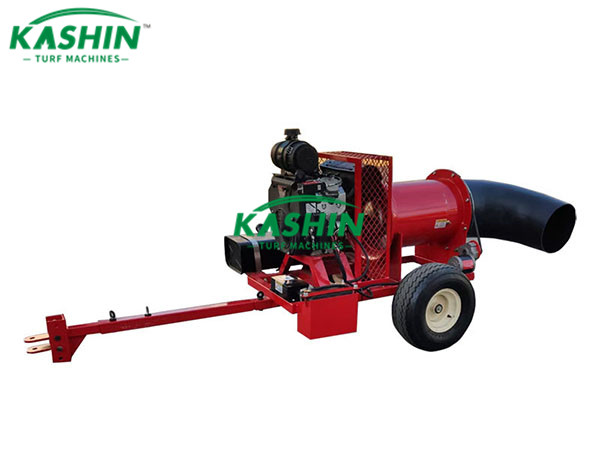
First, inspect the whole putting green to check snow mold, dead grass, low-lying waterlogged areas and surface undulations. Dead leaves, straw and organic debris covering bentgrass will block sunlight, reduce soil temperature and delay grass green-up. Use **turf blower** to quickly clear all litter and dead grass residues from the green surface. Manual cleaning takes enormous labor and may hurt fragile bentgrass crowns; **turf blower** can finish large-area cleaning efficiently without damaging turf.

After cleaning, check soil compaction and thatch depth.
Bentgrass greens easily accumulate thatch. When thatch exceeds 10mm, core aeration and light topdressing are necessary. After aeration, apply fine sand topdressing, and use **turf drag mat** pulled by **turf tractor** to spread sand evenly, fill aeration pores and blend sand into bentgrass canopy. This operation dilutes thatch, improves soil permeability and helps roots activate faster.
Check surface drainage in early spring.
Melting snow and spring rain easily gather in depressions, leading to root rot of bentgrass. The **lazer grader blade** mounted on **turf tractor** can precisely level small bumps and low spots of putting greens, optimize surface slope and eliminate standing water. After grading, use **field top maker** for gentle rolling, stabilize the topdressing layer and create a smooth putting plane without compacting the root zone. During spring renovation, **turf trailer** helps transport fine sand, fertilizer and seeds conveniently.
Fertilization in spring must be controlled strictly.
Do not apply high nitrogen fertilizer too early. Choose slow-release starter fertilizer to promote root growth instead of fast leaf growth. Keep following the one-third mowing rule and gradually reduce mowing height as bentgrass grows steadily.
### Summer: Heat stress control, disease prevention and surface protection
Summer high temperature is the biggest threat for bentgrass.
Bentgrass is cool-season turf, vulnerable to heat stress. Raise cutting height slightly in hot weather to protect grass crowns. Reduce nitrogen application, increase potassium supply to improve heat resistance. Water deeply in early morning instead of frequent shallow irrigation, avoid long-time leaf wetness to prevent brown patch and dollar spot disease.
Carry out light needle-tine aeration in summer to relieve mild compaction, avoid heavy hollow coring which causes long recovery time.
Inspect putting green surface every day, repair ball marks and divots timely. Before golf tournaments, use **field top maker** to refine surface smoothness, guarantee consistent ball roll for players. Clean grass clippings and dew residue with **turf blower** every morning.
### Autumn: Thatch reduction, root reserve accumulation for winter
Autumn is the golden period for bentgrass to store nutrients and strengthen roots.
Carry out core aeration and topdressing again for greens with thick thatch. Use **turf drag mat** to spread sand dressing uniformly. Remove fallen leaves continuously with **turf blower**, because fallen leaves cover bentgrass and easily trigger snow mold in winter.
Switch fertilizer formula to high-potassium winter fertilizer, reduce nitrogen dosage gradually. Slowly raise the mowing height as temperature drops.
Clean drainage channels, check surface flatness, repair small depressions by **lazer grader blade** before winter arrives. Use **turf trailer** to transport sand and maintenance supplies for autumn turf renovation.
### Winter: Dormancy protection & equipment maintenance
Bentgrass enters dormancy in winter. Avoid heavy machine driving and foot traffic on frozen putting green.
Pressure on frozen bentgrass crowns will form large dead patches in spring. During off-season, inspect and maintain your whole equipment fleet: **turf tractor**, **turf drag mat**, **lazer grader blade**, **field top maker**, **turf blower** and **turf trailer**. Repair and replace worn parts, so you can start spring **bentgrass putting green maintenance**
